Yui Christmas Adventure: Candies, Double Jumps and Safer Routes
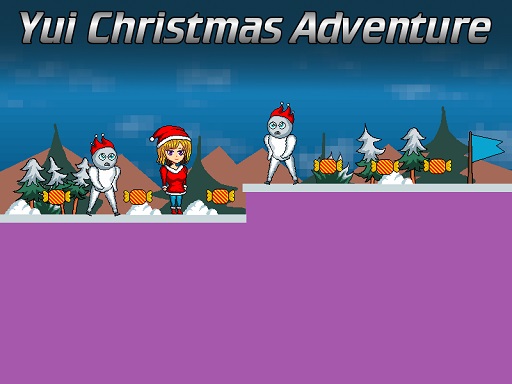
Candy collection changes how you should approach Yui Christmas Adventure. Reaching the far side of a level is only part of the job: Yui needs to gather every candy and arrive at the blue flag while avoiding the hazards between them. A direct run toward the exit can therefore leave an unfinished route behind you. The useful question is not simply how to move right, but how to visit the required places and still have a safe way forward.
This guide concerns the original Yui Christmas Adventure, rather than its sequel or another Christmas platformer. It is a two-dimensional game with eight levels, snow monsters, ground saws and spikes. The seasonal artwork gives the journey its setting; the real challenge comes from reading distances, controlling jumps and noticing where the remaining candies require you to travel.
Learn the two jump inputs before planning a route
The listed movement controls are WASD or the arrow keys. Press W or Up twice to perform a double jump. Choose one arrangement and stay with it while learning. Switching between layouts during a difficult sequence adds an unnecessary decision, particularly when you need a second jump before reaching a platform. Test ordinary movement and the second jump in a clear area before attempting a passage beside a hazard.
Treat a double jump as two decisions rather than a single long button press. The first input begins the movement; the second changes what you can reach while already airborne. Watch how much room remains beneath Yui and where the intended landing will be. Repeated tapping without looking can spend the second input before it is useful. Deliberate timing makes it easier to understand why a successful jump worked and to repeat it later.
You do not need to memorize every distance immediately. First learn whether an intended landing is comfortably within reach, near the edge of your current ability, or clearly unsuitable. Those three judgments are enough to improve early decisions. A route that repeatedly demands the most difficult jump is a poor practice route if a simpler way to the same candy is available.
Read candy positions as part of the level
Before crossing a dangerous stretch, look at the candies you can already see and connect them to potential landing places. An item directly above a safe surface presents a different problem from one beside spikes. In the first case, the surface can provide a recovery point. In the second, the approach and the departure both need attention. Collecting the item is not a useful success if the movement then leaves Yui heading into danger.
Separate the route into small sections with a clear beginning and end. For example, identify a safe standing place, the next candy you want, and the place you intend to land afterward. This is a planning example, not a fixed walkthrough for a particular level. The same method works when the layout changes because it asks you to read the current screen instead of copying a remembered sequence blindly.
When several candies are visible, avoid committing to the nearest one automatically. Check whether collecting it first makes the others awkward to approach. A slightly longer movement across safe ground can be preferable to returning through a difficult passage. Route planning here is about reducing unnecessary exposure, not about assuming there is a hidden reward for the shortest possible path.
Give each hazard its own response
Snow monsters, ground saws and spikes all make careless contact dangerous, but they should not become one vague category in your mind. Spikes mark space you need to clear. A saw requires you to pay attention to the area it occupies. A monster asks you to read its position relative to the intended movement. Look at the actual arrangement before deciding whether to wait, jump or choose a different approach.
Do not assume that an obstacle can be defeated by landing on it. The objective is to avoid the listed threats while collecting candies. Advice borrowed from another platform game can be actively unhelpful here. If a passage looks like an invitation to jump on a creature, check the game's own behavior rather than treating familiar artwork as proof that a familiar combat rule applies.
Leave yourself some room around a hazard when the layout permits it. A jump that barely clears a spike may succeed once and still be difficult to reproduce. A more generous approach gives you more time to observe the landing and correct the next decision. Precision improves most reliably when you can distinguish a planned clearance from a fortunate escape.
Decide when the second jump is useful
The second jump is especially valuable when an ordinary jump does not provide the position you need. However, having that option does not mean every movement needs it. On an easy gap, an unnecessary second input may complicate the landing. Start with the simplest movement that appears sufficient, then use the additional jump deliberately when the route calls for more reach or a different airborne position.
If you keep missing the same candy, diagnose the miss before changing everything. Were you too far sideways when you began? Did you use the second input too early? Were you aiming at the item without choosing a landing? Each explanation suggests a different adjustment. Change one part of the attempt so that the next result tells you something useful instead of becoming another unrepeatable experiment.
For a difficult landing, look at the surface rather than keeping your attention fixed on Yui's head. Your goal is to place the character safely, not merely to create a tall jump. Thinking about the landing also helps you avoid holding a movement direction for longer than necessary once you have crossed the obstacle.
Use the blue flag as a final check
The blue flag is the destination for advancing to the next level. Since the stated objective includes collecting all candies, build a habit of checking your collection before treating the approach to the flag as finished. If something remains, identify where it is and whether your current position gives you a sensible way to reach it. Rushing toward the exit before inspecting the remaining route can create extra backtracking.
A missed candy is useful information. Ask whether it was overlooked, deliberately postponed, or attempted unsuccessfully. An overlooked item calls for better scanning. A postponed one calls for a more complete route plan. A difficult one calls for movement practice. These are separate problems, so there is little value in responding to all three by simply trying to run faster next time.
Across the eight levels, expect the challenge to increase, but keep reading what is actually on screen. A method that worked earlier may need a different starting position later. Carry forward the habit of observing, planning and checking the landing; do not assume every new arrangement is the same jump with a different background.
A useful practice session
Spend an initial attempt learning movement and recognizing the hazards. In a later attempt, concentrate on a single uncertain section. Your practice goal might be to collect a particular candy and land cleanly, rather than complete everything at once. Small goals make progress visible even when the entire level still needs work, and they keep you from confusing familiarity with the opening area with mastery of the difficult part.
After a mistake, describe it in concrete terms: the jump began too late, the landing was not checked, or the candy route required a return you had not planned. This is more useful than deciding you need better reflexes in general. Reflexes matter, but a specific observation gives you something you can actually change on the next attempt.
If you want a different kind of short challenge after practicing, the Arcade Games collection provides a broader starting point. Games grouped there can ask for very different controls and objectives. Use the instructions for the next game you choose rather than carrying Yui's double-jump inputs into an unrelated title.
Questions to settle before a longer attempt
Are you playing the original or Yui Christmas Adventure 2? Check the page name before following a route from another guide. Similar character art does not make two level layouts interchangeable. This article is about the original eight-level adventure and its candy-collection objective, so a sequel's obstacles or solutions should not be assumed to apply.
Does the keyboard reach the game? Click into the game area and try a short movement in a safe place. If the browser responds instead, fix focus before attempting a difficult jump. A control problem and a timing mistake can look similar, but practicing harder will not solve a key press that never reaches the game.
What should you prioritize when a candy is near danger? Plan the whole movement, including the landing, and judge whether another approach is safer. Collecting everything matters, yet repeated hurried attempts are rarely the clearest way to learn a demanding spot. The strongest route is one you understand well enough to repeat: candies accounted for, hazards read carefully, double jumps chosen deliberately, and a controlled arrival at the blue flag.